Showing posts with label article. Show all posts

Sunday, October 7, 2007

100th Post! And it's about GUNDAM! Japan officials edited Wikipedia at work

Japan officials edited Wikipedia at work

From Yahoo! News:

TOKYO - Japan's Agriculture Ministry reprimanded six bureaucrats after an internal probe found they spent work hours contributing to Wikipedia on topics unrelated to farm issues — including 260 entries about cartoon robots.

The six civil servants together made 408 entries on the popular Web site encyclopedia from ministry computers since 2003, an official said Friday.

One of the six focused solely on Gundam — the popular, long-running animated series about giant robots — to which he contributed 260 times. The series has spun off intricate toy robots popular among schoolchildren as well as adults known as "otaku" nerds.

"The Agriculture Ministry is not in charge of Gundam," said ministry official Tsutomu Shimomura.

SOURCE

GUNDAM FIGHT!


One of my prized possessions: a Gundam Wing Zero Collectible!


Special thanks to J. Ho for bringing this news article to my attention. Check out his art blog, he loves drawing robots and He-Man. Now if only he'd draw robotic He-Man.

Thursday, September 27, 2007

BONUS POST! Follow-up on Mysterious Meteorite Illness

I posted this story on 9/18/07. Here's a follow-up:

"On what started as a normal Saturday night one week ago, residents of a small, remote Peruvian town saw a bright light streak across the sky, heard a resounding bang and suddenly found themselves at the center of a media frenzy.

Initial suspicions of an airplane crash quickly spiraled into widespread reports that a meteorite had plummeted to Earth and left a smoking, boiling crater whose supposedly noxious fumes were reported to have sickened curious locals who went to peer at the hole.

Despite doubts expressed by geologists that the crater was actually caused by a meteorite and firm explanations that a meteorite would not even emit fumes and that the "sickness" was likely a case of mass hysteria, numerous onlookers far and wide were fascinated by the idea that this event could be some real-life "Andromeda Strain" (the 1969 novel by Michael Crichton), where a mysterious rock falling to Earth from outer space made anyone who went near it ill."

SOURCE

Mass hysteria seems to have caused the 'illness'. A sort of mass psychosomatic reaction.

Tuesday, September 18, 2007

BONUS POST! Diseased Meteor Will Kill Us All!


LIMA (AFP) - Villagers in southern Peru were struck by a mysterious illness after a meteorite made a fiery crash to Earth in their area, regional authorities said Monday.

Around midday Saturday, villagers were startled by an explosion and a fireball that many were convinced was an airplane crashing near their remote village, located in the high Andes department of Puno in the Desaguadero region, near the border with Bolivia.

Residents complained of headaches and vomiting brought on by a "strange odor," local health department official Jorge Lopez told Peruvian radio RPP.

Seven policemen who went to check on the reports also became ill and had to be given oxygen before being hospitalized, Lopez said.

Rescue teams and experts were dispatched to the scene, where the meteorite left a 100-foot-wide (30-meter-wide) and 20-foot-deep (six-meter-deep) crater, said local official Marco Limache.

"Boiling water started coming out of the crater and particles of rock and cinders were found nearby. Residents are very concerned," he said.

SOURCE


OTHER RELATED HISTORICAL AND FICTIONAL METEOR STORIES:

TUNGUSKA EVENT

The Tunguska event, sometimes called the Tunguska explosion, was a massive explosion that occurred near the Podkamennaya (Under Rock) Tunguska River in what is now Krasnoyarsk Krai of Russia, between 7:00 and 8:00 AM on June 30, 1908.

The explosion was most likely caused by the air burst of a large meteoroid or comet fragment at an altitude of 5 to 10 kilometers (3–6 mi) above Earth's surface. Different studies yielded varying estimates for the meteor's size, including 60 meters, 90 to 190 meters and up to 1200 meters in diameter.

Although the meteor or comet is considered to have burst prior to hitting the surface, this event is still referred to as an impact event. The energy of the blast was estimated to be between 10 and 20 megatons of TNT — 1,000 times more powerful than the bomb dropped on Hiroshima. The explosion felled an estimated 80 million trees over 2,150 square kilometers (830 sq mi). It is estimated to have measured 5.0 on the Richter scale.

The Tunguska event is the largest impact event in recent history. An explosion of this magnitude had the potential to devastate large metropolitan areas had it occurred over a large city. This possibility has helped to spark discussion of ways to potentially stop large asteroids or comets from hitting Earth.

SOURCE

THE BLOB


THE ANDROMEDA STRAIN

Friday, September 14, 2007

A Cornucopia of Cyborgs and Robots

Well, this is a HUGE post today. Got some pop culture stuff and a lot of scientific research here. I hope everyone enjoys. Be sure to post your thoughts!

One of my favorite comic book characters.


Robot maker builds artificial boy


RICHARDSON, Texas - David Hanson has two little Zenos to care for these days. There's his 18-month-old son Zeno, who prattles and smiles as he bounds through his father's cramped office. Then there's the robotic Zeno. It can't speak or walk yet, but has blinking eyes that can track people and a face that captivates with a range of expressions.

At 17 inches tall and 6 pounds, the artificial Zeno is the culmination of five years of work by Hanson and a small group of engineers, designers and programmers at his company, Hanson Robotics. They believe there's an emerging business in the design and sale of lifelike robotic companions, or social robots. And they'll be showing off the robot boy to students in grades 3-12 at the Wired NextFest technology conference Thursday in Los Angeles.

Unlike clearly artificial robotic toys, Hanson says he envisions Zeno as an interactive learning companion, a synthetic pal who can engage in conversation and convey human emotion through a face made of a skin-like, patented material Hanson calls frubber.

"It's a representation of robotics as a character animation medium, one that is intelligent," Hanson beams. "It sees you and recognizes your face. It learns your name and can build a relationship with you."

It's no coincidence if the whole concept sounds like a science-fiction movie.

Hanson said he was inspired by, and is aiming for, the same sort of realism found in the book "Supertoys Last All Summer Long," by Brian Aldiss. Aldiss' story of troubled robot boy David and his quest for the love of his flesh-and-blood parents was the source material for Steven Spielberg's film "Artificial Intelligence: AI."

He plans to make little Zenos available to consumers within the next three years for $200 to $300.


READ MORE

ZENO'S OFFICIAL SITE

ZENO'S BLOG!


BUILDING GODS
A movie wherein a cyborg, brain builder, theologian, and philosopher debate the future of artificial intelligence, robotics, cyborgs, and living inside of computers.


OFFICIAL SITE


BRAINGATE


BRAINGATE HOMEPAGE


REAL TRANSFORMER

Monday, August 27, 2007

Hackers Take Down the Most Wired Country in Europe

FROM THIS MONTH'S WIRED:

The minister of defense checked the Web page again — still nothing. He stared at the error message: For some reason, the site for Estonia's leading newspaper, the Postimees, wasn't responding. Jaak Aaviksoo attempted to pull up the sites of a couple of other papers. They were all down. The former director of the University of Tartu Institute of Experimental Physics and Technology d been the Estonian defense minister for only four weeks. He hadn't even changed the art on the walls.

An aide rushed in with a report. It wasn't just the newspapers. The leading bank was under siege. Government communications were going down. An enemy had invaded and was assaulting dozens of targets.

Outside, everything was quiet. The border guards had reported no incursions, and Estonian airspace had not been violated. The aide explained what was going on: They were under attack by a rogue computer network.

It is known as a botnet, and it had slipped into the country through its least protected border — the Internet. Ministers of defense develop strategies to combat the threat of missile attacks, naval bombardment, air raids, and tank advances. But a digital invasion? Estonia is a member of both NATO and the European Union. Should Aaviksoo invoke NATO Article 5, which states that an assault on one allied country obligates the alliance to attack the aggressor?

SOURCE

Friday, August 24, 2007

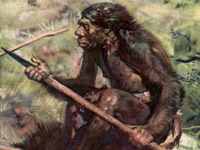
Women Dig Cavemen

Here's this week's post. Enjoy!


Jeanna Bryner
LiveScience Staff Writer
LiveScience.com Thu Aug 23, 12:35 PM ET

Guys with bulldog-like faces have been chick magnets throughout human evolutionary history.

A recent study of the skulls of human ancestors and modern humans finds that women, and thereby, evolution, selected for males with relatively short upper faces. The region between the brow and the upper-lip is scrunched proportionately to the overall size of their heads.

Among the men who fit the bill: Will Smith and Brad Pitt.

In a past study, researchers found a similar facial pattern in chimpanzees, with males having relatively shorter and broader faces compared with females, controlling for body size.

Men with "mini mugs" might have been most attractive to the opposite sex and thus most likely to attract mates for reproduction, passing along the striking features to the next generation and so forth, said lead study author Eleanor Weston, a paleontologist at the Natural History Museum in London.

"The evolution of facial appearance is central to understanding what makes men and women attractive to each other," Weston said. "We have found the distance between the lip and brow was probably immensely important to what made us attractive in the past, as it does now."

Whereas past studies have suggested facial symmetry and facial masculinity play roles in this game of desire, none have provided evidence of an evolutionary shaping of male and female faces.

"I think it's a very nice approach," said Randy Thornhill, an evolutionary psychologist at the University of New Mexico, referring to the study. Though not involved in it, Thornhill agrees with the finding that certain facial features evolved due to sexual selection.

Facial coordinates

The researchers calculated certain facial coordinates on 68 males and 53 female skulls from a contemporary native southern Africa population ranging in age from infant to 30 years old. Measurements included distances between the point between the eye brows and upper lip and from cheekbone to cheekbone.

Weston and her colleagues also examined facial data from fossil hominin skulls dating back to 2.6 million years ago, unearthed in Kenyan deposits as part of the Koobi Fora Research Project IV. These skulls represented five species: Homo erectus, Homo ergaster, Paranthropus boisei, Australopithecus africanus and Paranthropus robustus. These facial coordinates were then compared with the contemporary coordinates.

In spite of their bulkier bodies (about 15 percent more massive than women's bodies), and similarly broader faces, men have upper faces similar in height to women's faces, the scientists found. But compared with the rest of the head, a guy's mid-face is compressed. The differences held throughout human history.

A simple ratio of upper face length to broadness could serve as a proxy for facial attractiveness, the scientists say in a report on their research published in the online journal PLoS ONE.

Masculine appeal

The scientists are not certain why today's distinctive male face and its proportions evolved.

"A shorter upper face does serve to exaggerate the size of other face features such as the flare of the cheeks and the size of the jaw, but this might not be why it developed," Weston told LiveScience. "Rather the shorter [and] broader the male face the more ‘masculine’ and the less ‘feminine'—based on biological face changes that take place during growth and development—the individual becomes," she said.

Also, this facial development was accompanied by a shrinking of guys' canine teeth, so men appeared less threatening to competitors, yet attractive to mates.

While the scientists who authored the current study examined skulls and did not specifically study how modern faces fit the findings, the Natural History Museum press officers applied Weston's findings to a "quick and dirty" survey of photos of celebrities.

They came up with a list of stars with masculine faces, listing them from most to least masculine according to facial dimensions: Will Smith, Peter Andre, Justin Timberlake, Thierry Henry, Brad Pitt, David Beckham, Johnny Depp and Kanye West.

Visit LiveScience.com for more daily news, views and scientific inquiry with an original, provocative point of view.

SOURCE